Working late into the Night


mk whistle polishing photo


Fruit on the G Tree?

G mk low whistle prototypes photo

Design Options – In Depth: Part 3

It has been a revealing experience so far going back over all this previous work on the toob key design. All these ideas have had the first flush of enthusiasm hammered out of them now and it’s good to look back at them in a new light. This week in particular we’ve been seized by a new passion for the fabric hinge seen in the previous ‘Part 2‘ post. Talking it through again we really feel that there’s more work to be done to explore the potential of this approach to the design.

Today however, I’d like to show you another design idea we’ve been considering;

110228 key family tree design options pt 31 179x300 photo

In previous posts you’ll have seen us exploring a wrap round flat leaf spring to provide the spring force to the key. This concept takes this one step further with the idea of a formed and profiled spring that carries both the spring and hinge functions.

101214 single spring key 300x275 photo

This is similar to the fabric hinge, but the defined hinge point is provided by the formed spring. The advantage of this is that it could be a very simple and elegant assembly, only requiring the key and the spring. The spring can be cut as flat sheet by etching or laser cutting giving potentially more complex forms or engraving.

Looking further into spring production suggests we may need larger production runs to justify them or tooling up the mk workshop with some new kit.

Below is a short video capturing the output of a quick analysis model I did to get a feel for how a key like this would behave in terms of its displacement.

101216 spring fea

To be a successful key, the spring action of the key needs to be responsive, we have a concern that the shape shown above would actually offer too much resistance because the material at the hinge part and the ‘leaf’ part both contribute. This could probably be engineered out at a later stage though.

Another interesting potential for the design is the idea of linking the springs together into one smooth element, for examples between the Bb and C natural keys which happen to be closely spaced.

This concept has stalled a bit at the moment due to the difficulty of getting spring samples made up, but as ever we’d be interested to hear your views on this.

Design Options – In Depth: Part 2

Following on from my previous posts on the toob key design (overview, Part 1) and moving further through the “family tree” I’d like to take you through our ideas on a fabric hinge for the toob keys.

110228 key family tree design options pt 2 171x300 photo

This idea came out of our pre-occupation with the offset of the fingerpad from the tonehole along the toob. This was combined with the desire to achieve a low profile solution to hinging the keys.

101214 fabric hinge assembly 877x1024 photo

As you may have seen in Misha’s video post earlier, his model based on this concept worked well and gives us the sort of feel that we’re aiming for. The main unresolved issue is how to fix the fabric in place. Mechanical fixings seem to be unlikely to be the answer due to the thinness of sheet or plate being used and the difficulty of achieving a reliable thread in it.

Adhesives would be the more likely solution to assemble this concept, however we will need to do some further research to find production quality adhesives with a known reliable lifespan.

As always your comments are always appreciated, I’ll be trying to get this updated more regularly too…

Notes from the workshop: keeping the edges

One of the most challenging parts in making whistles (and I suspect lots of other instruments) is keeping the corners and edges sharp.  The fipple – the edge the airstream is directed onto – for example,  is one of the most important parts in the formation of a good tone.  Also, the edges of the tone holes are the extremely influential with tuning and intonation.

But by their very nature, edges are exposed, making them vulnerable to getting rounded off.  From a makers perspective it’s awkward because if we didn’t have to maintain the edges, we’d just be able chuck the assembled instruments in an automatic polishing machine and collect the beautifully shiny whistles an hour later.  In a similar vein, it’s always been said that you can tell the quality of a flute by whether the keywork has any hard lines or edges – on the cheaper models everything’s been rounded off in the finishing process.

Obviously edges need to be deburred and finished so as to be safe to touch, but rounding out the tone-hole edges on whistles means that some form of ‘indiscriminate’ finishing has been used, which attacks the edges – pushing sandpaper or a scotchbrite pad up against the body as it spins on a machine might be an example.  The difficulty here is that, although it gives a good overall finish to the eye, it rounds off the edges, and by the very nature of this kind of abrasive process, it’s difficult to do consistently, with these inconsistencies then work their way through to the tuning and intonation.

It’s one thing to identify a problem though, and an entirely different matter to solve it!   It’s also true that soemtimes the answer might’ve been starring you right in the face – for ten years!  Thankfully focusing in on this has produced some good processes and techniques, and it’s something we’ve made good progress with.


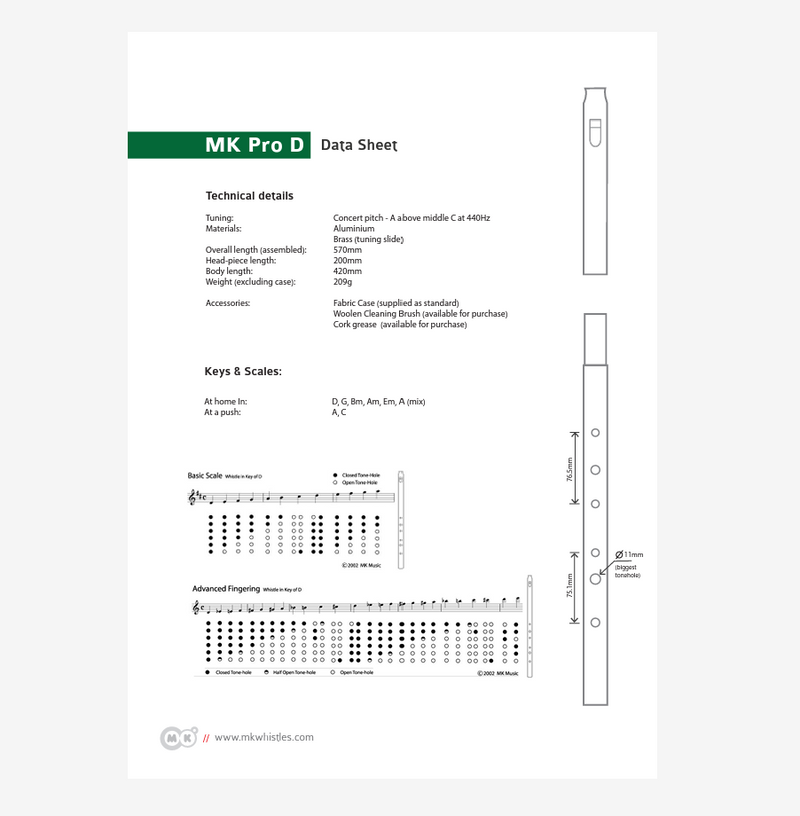
Mk D Datasheet

D datasheet photo

Here’s a first draft of a Datasheet for the Mk Low D.  What do you think?  Is there any info which isn’t there but could be useful?  Any inaccuracies?

Please use the comments to let us know what you think – your feedback is much appreciated.


Fabric Hinge

After Brian’s excellent posts last week here’s a small video of an audacious idea.  What do you think?  Could it work?


Design Options – In Depth: Part 1

Following on from yesterday’s post on the ‘Family Tree’ of design options for the Toob keys, I’d like to talk you through;

110131 key family tree design options pt 1 196x300 photo

This concept sees the spring which holds the key shut, not as an additional component, but as being integral to the structure of the key;

100715 whistle curved key 4 cropped photoThe sketch above explores the extreme case where there really is no pivot action at all and the key rolls across the whistle tube. This seemed to need your finger to travel further than on the traditional key, so we looked again at having a more defined pivot form on the surface of the whistle tube or integrated into the key form;

IMG 5725 small photo IMG 5727 small photo

Taking the ‘pivot on key’ approach as being the simpler;

110201 cam pivot explanation 1 photo

We then got ourselves away from the computer and made a quick sketch model in the workshop to test the feel of this kind of action.

110201 pivot exp 0 photo

The leaf spring itself was clamped solidly against the whistle body, and the spring force held the tonepad end of the key against the body well. The two short grub screws acted as our ‘pivot forms’ and allowed us to adjust the playing height. The action did work, and had the interesting effect of being quite ‘floaty’ and analogue, which could be interesting for certain playing styles with bends on notes. Likely it was far too ‘floaty’, but that could be tune-able by changing the spring length and the pivot position. What did feel like a major weakness however was how the key responded to off centred finger pressure, this is important as most of the keys will have a short dog leg to allow the key to be reached comfortably from just above or below where the tone hole actually needs to be. If you pressed on the very edge of the key in the model above to simulate this, you then found that the key would lift itself off of the body at an angle. You can see this in the photo below right where the pivot is starting to come away from the slight indents in the Toob body used to locate the pivots;

110201 pivot exp 1 photo 110201 pivot exp 2 photo

Our conclusion from this exercise was that the concept was interesting and very minimal and elegant, but that the need to have our offset fingerpads would mean a return to the drawing board…

The Woodwind Key Family Tree

Greetings once again from the MK-workshop, despite the relative radio silence on these pages on the subject of the Toob chromatic whistle, things have been ticking over. Now seems like the right time to get the work we’ve done out there and get some feedback on some of the ideas, so I hope you’ll get involved in the comments below. Part of preparing this is also to aid us in pulling together what we’ve done and trying to get an overview of the design options.

A Family Tree

Starting from the basics, we are looking to create a chromatic whistle.  One of the interesting challenges faced with the design of any chromatic woodwind instrument, is that you only have nine effective fingers (you need a thumb to balance the instrument on), but there are twelve notes in the chromatic scale to cover. Therefore we inevitably have to add keys, so the first question is, what form can keys take?

110131 key family tree photo

The above diagram is an attempt to broadly categorize the various types of key mechanisms to be found on woodwinds. You can have one which is normally in its open state until actuated or one starting in the closed position. Depending on the key arrangement and the player’s hand posistion, keys will work along the body of the instrument or around it. The aim with the ‘Toob’ is to create keys which are normally closed and that act around the body of the whistle, as we are adding notes and keys whilst retaining a familiar playing position for trad whistle players.

So we focussed very quickly in on this particular ‘species’ of key and a melting pot of different key ‘breeds’ has evolved;

110124 key family tree design options web photo

The option above left ‘posts with pin hinge and spring’ is very much our base option, that formed the results of Misha’s previous bout of prototyping and development. This is a strong and solid foundation for the design, it tested the key positions for comfortable play and uses a mechanism that is tried and tested. Looking at it together and asking what more could we do to push the design of the Toob further, we homed in on the way that these keys clutter the top surface of the instrument. Depending on the size of the player’s hands the protruding key mechanisms could be a hindrance.

IMG 5626 300x225 photo

From this starting point, what you see in the other options shown above were attempts to create a key mechanism that is as low-profile as possible. Our broad two ‘sub-species’ then were the ideas of an ‘overslung’ (as in the original case) or ‘underslung’ key, which has its mechanism below the  body of the whistle. The ‘underslung’ key is perhaps the extreme case, making the upper tactile surface of the whistle completely smooth and visually clean. An underslung key requires the same mechanism as the overslung, but with an additional actuator which faces the fingers of the player. This additional complexity hasn’t made it a favourite at the moment.

An ‘overslung’ key has two main functional elements; a pivot point and a spring which holds the tonepad in position. The spring force specification has to offer a key which is light and responsive to the musician’s touch but robust and reliable in holding the tonepad closed. In all of the options above we have explored replacing the traditional woodwind key springs with flat leaf springs that are very much more part of the key structure and used in a very visible way. What particularly distinguishes the various options though is the approach to creating a pivot, from not having a pivot at all but rather a cam action over the whistle to retaining a hinge pin against the whistle with a plate element.

As you can see from the images in our family tree we’ve spent quite a bit of time prototyping these ideas and directions and I think it’s worth describing each of them in more detail. So please check back with the MK Design Blog over the coming days for a more in-depth look at our key concepts, taking each in turn.

Some Initial Sketches

This is the first of a series of posts where we aim to throw open the doors to what’s going on in the mk workshop to let the community (that’s you) in, to encourage, chastize, criticise and suggest, or whatever you feel..

100715 whistle curved key 5 small 300x248 photo

These sketches are really purely aesthetic, we have a number of functional ideas floating around for the keys that will follow in future posts. For now I really just wanted to bounce around some of our overall goals for the toob. One of the over-riding aims apart from meeting the same build quality as the existing whistles is to create an instrument that is simple, clean and elegant. To achieve a chromatic whistle without the overt mechanical complexity of a classical flute.

100713 whistle curved key 1 300x240 photo

100715 whistle curved key 3 300x240 photo

Watch this space…


Translate

    Translate to: